Signed in as:
filler@godaddy.com

At Scotland Child Therapy, our mission is to provide high-quality counseling services to individuals, couples, and families who are experiencing emotional or psychological difficulties.

Cognitive Behavioral Therapy (CBT): Explores how thoughts, feelings, and actions are linked. It is highly structured and teaches practical coping skills to reframe negative thought patterns. It is widely used to treat anxiety, depression, and obsessive-compulsive disorder (OCD).
Dialectical Behavior Therapy (DBT): Adapted for older children and with severe emotional dysregulation. It focuses on teaching mindfulness, distress tolerance, and healthy coping mechanisms to manage intense emotions.
Acceptance and Commitment Therapy (ACT): Helps children accept and understand their inner emotions rather than fighting them, allowing them to move forward positively.
These approaches teach children to identify, understand, and manage their internal world.
Cognitive Reframing: Teaches children how their thoughts directly change their feelings and behaviors.
Mindfulness: Focuses on breathing and staying present to manage overwhelming emotions.
Emotional Regulation: Helps children identify intense feelings and find healthy ways to calm down.

These approaches focus on changing actions, learning new habits, and reinforcing positive behaviors.
Applied Behavior Analysis (ABA): An intensive therapy most commonly used for autistic children. It relies on positive reinforcement to help children build social, adaptive, and communication skills while reducing harmful behaviours.
Exposure Therapy: Frequently used for phobias and anxiety. Therapists systematically and safely expose a child to a feared object or situation in a controlled environment, with small incremental steps, to reduce fear and anxiety over time.
Habit Reversal Training (HRT): Simply put this method teaches physical alternatives to interrupt repetitive body movements or tics. A targeted approach designed to help children manage unwanted repetitive behaviors such as tics,skin-picking, or hair-pulling by replacing them with alternative actions.
Family Therapy (Systemic): Involves the entire family unit ,or parts of, rather than just the individual child. It focuses on resolving conflicts, changing unhealthy behavioral dynamics, and improving overall household or relationship communication.
Parent-Child Interaction Therapy (PCIT): A structured approach where a therapist coaches parents in real-time on how to interact with their child, strengthen their bond, and manage disruptive behaviors.
(NB: at the moment we do not have the space or facilities to use a one-way mirror and an earpiece so this is done in a blag de blah way instead ???!?!)
Dyadic Developmental Psychotherapy (DDP): An attachment-focused therapy designed for children who have experienced complex trauma or neglect. It heavily involves the primary caregiver to help the child feel safe and emotionally regulated.
Trauma-Focused Cognitive Behavioral Therapy (TF-CBT): A specialized form of CBT that integrates trauma-informed care, allowing children to safely process traumatic memories and reduce secondary PTSD triggers.
Interpersonal Psychotherapy (IPT): A short-term treatment adapted for older children struggling with depression and social struggles. It focuses strictly on improving personal relationships, resolving peer conflict, and coping with major life transitions.
These approaches focus on how the brain and body store stress, particularly after frightening events.
Bilateral Stimulation: Uses rhythmic tapping to help the brain file away difficult memories.
Somatic Regulation: Focuses on body awareness, teaching children how physical tension links to stress.

These approaches are also highly effective for our neurodivergent children who have a unique "operating system" or a distinct way of experiencing the world. Each method can be adapted to allow for their diverse thinking styles, heightened focus, creativity and capacity for detail.
Because children communicate naturally through play, therapists use toys, puppets, games and storytelling to help them process emotions or trauma, express hidden feelings, and build problem-solving skills.
We use drawing, painting, and sculpting as an emotional outlet for expression and understanding.
Therapeutic sandtray work lets children express complex emotions and trauma without needing to find the right words. In a safe environment, the child builds miniature worlds or scenes in a sand-filled tray using a wide collection of figures. This hands-on activity communicates directly with the deeper, emotional parts of the brain.
For children dealing with trauma, grief, or developmental delays, standard talk therapy can be overwhelming. The sandtray provides a protective distance where the toys act as stand-ins for their fears, wishes, or real-life relationships.
This can typically help with:
Emotional Regulation: providing a healthy, cathartic outlet to vent pent-up anger or anxiety.
Mastery and Control: By altering the scene, moving figures, or burying painful memories, the child gains a sense of control over their environment and emotions.
Metaphorical Processing: allowing a safe exploration of painful themes through fantasy and metaphor, slowly making sense of their real-world experiences.
Depending on the child's needs and the specific therapeutic approach, the therapist may ask the child to tell a story about their scene, or they may simply observe and document the arrangement of figures to understand the child's unconscious struggles.
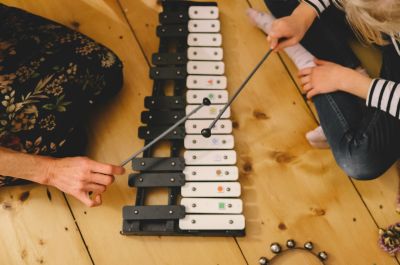
Therapeutic music work with children uses rhythm, melody, and sound as a creative, non-verbal outlet to regulate moods and build connection. It can help children process trauma, build emotional regulation, enhance communication skills, and improve social interaction because it creates:
Emotional Expression: Music bypasses traditional verbal defenses, allowing children to safely release pent-up anger, anxiety, or sadness through rhythm and volume.
Communication: For children who are non-verbal or on the autism spectrum, interactive music-making fosters connection, turn-taking, and active listening.
Confidence and Control: Participating in musical creation gives children a sense of agency and mastery over their environment.
Stress Reduction: Calming musical interventions are frequently used in hospital or hospice settings to lower heart rates, manage pain, and provide a sense of normalcy.
Some examples of the methods used include:
*Improvisation , whereby children are encouraged to freely play simple instruments to express feelings they may not be able to put into words. The therapist responds musically, creating a dialogue of support and understanding.
*Songwriting and Lyric Analysis: children may compose original songs or analyze existing lyrics to explore their identities, process grief, or work through difficult experiences.
*Structured Musical Play: children with developmental or physical challenges, therapists use targeted musical games to reach milestones like grasping instruments, improving motor coordination, or increasing attention span.
We provide a safe, playful environment where toddlers and young children can express feelings they cannot yet put into words and can help with:
• Translating Big Feelings: Young kids often show distress through tantrums, biting, or crying. Therapy helps them understand and manage intense emotions like anger or fear.
• Navigating Early Transitions: It provides targeted support for major life shifts, such as starting nursery, welcoming a new sibling, or adapting to parental separation.
• Soothing Separation Anxiety: Therapists give children and parents practical tools to handle intense distress during drop-offs, bedtime routines, or times apart.
• Addressing Physical Signs: Stress in young children often shows up physically. Therapy can help resolve unexplained stomachaches, sleep issues, or regression in toilet training.
• Strengthening Parent Bonds: Early childhood therapy often includes parents, teaching you how to co-regulate with your child and understand their behavioral cues.
Therapeutic music work with children uses rhythm, melody, and sound as a creative, non-verbal outlet to regulate moods and build connection. It can help children process trauma, build emotional regulation, enhance communication skills, and improve social interaction because it creates:
Emotional Expression: Music bypasses traditional verbal defenses, allowing children to safely release pent-up anger, anxiety, or sadness through rhythm and volume.
Communication: For children who are non-verbal or on the autism spectrum, interactive music-making fosters connection, turn-taking, and active listening.
Confidence and Control: Participating in musical creation gives children a sense of agency and mastery over their environment.
Stress Reduction: Calming musical interventions are frequently used in hospital or hospice settings to lower heart rates, manage pain, and provide a sense of normalcy.
Some examples of the methods used include:
*Improvisation , whereby children are encouraged to freely play simple instruments to express feelings they may not be able to put into words. The therapist responds musically, creating a dialogue of support and understanding.
*Songwriting and Lyric Analysis: children may compose original songs or analyze existing lyrics to explore their identities, process grief, or work through difficult experiences.
*Structured Musical Play: children with developmental or physical challenges, therapists use targeted musical games to reach milestones like grasping instruments, improving motor coordination, or increasing attention span.